

Réunion island’s new ship repair capability


Réunion island brings European ship repair in the Indian Ocean
Réunion island in the Indian Ocean is an overseas Department and region of France within the African region. Part of the Mascarene Islands, it is located some 679km (367 nautical miles) east of Madagascar and 175km (94 n-miles) southwest of Mauritius. The island’s ship repair capabilities have recently been upgraded with the acquisition of a floating dock able to dry dock vessels up to 4,600 tons and 120m long.
Commercial operations will begin in April with the dry docking of the French Navy’s BSAOM Champlain, built by Piriou shipyards. The dry docking, which will last about two months, is being carried out by Piriou Reunion.
Gilles-Ham-Chou-Chong (GHCC) is Deputy General Manager of Grand Port Maritime de La Réunion (GPMDLR), and Christophe Lagathu (CL) is CEO ship repair and in-support at Piriou Group and General Manager of Piriou Reunion.
Gilles-Ham-Chou-Chong (GHCC)
Christophe Lagathu (CL)
Q. What was the rationale for acquiring a dry dock and why that size?
GHCC: The acquisition of the floating dry dock stems from a clear strategic ambition: to repatriate to Réunion Island all naval maintenance operations that until now often had to be undertaken abroad. By equipping the port with a high‑capacity industrial asset, designed to accommodate both local fishing vessels and state-owned ships, Port Réunion is positioning itself as a major regional player in ship repair.
The choice of a dock of this size is no coincidence: it is a versatile format, large enough to meet regional demand while remaining compatible with the Port Ouest infrastructure, strengthened as part of the Quay 9 anchoring project.
Q. How long had you been looking for one?
GHCC: Finding a suitable floating dry dock is the result of long‑term work. Several years were needed to identify equipment that was technically reliable, financially sustainable and compliant with local environmental requirements. The administrative milestones – including the prefectural authorisation – demonstrate a project that has been carefully prepared and fully aligned with the port’s long‑term strategy.
Q. Was it always going to be a second-hand dry dock or had you considered getting one built?
GHCC: While the option of a newly-built dock was examined, the chosen scenario quickly shifted toward a fully refurbished second‑hand dock, offering the ideal balance between performance, deployment speed and budget control. The refurbishment operations – carried out in Cape Town, South Africa – made it possible to deliver a fully operational asset while significantly reducing the delays inherent in constructing a brand‑new unit.
Q. When and from where did you acquire it?
GHCC: The floating dock Titan was acquired in 2024 and then transferred to the port of Cape Town, where it remained for several months to undergo a complete renovation before being loaded onto the transport vessel. Its departure from South Africa marked a decisive step toward its permanent installation in Réunion.
Q. What sort of work was needed before it could be moved to Réunion?
GHCC: Even before setting sail, the dock underwent a major refurbishment programme, including:
– compliance with technical standards
– rehabilitation of all equipment
– full validation of immersion trials.
These works were carried out in Cape Town and ensured both safe transport and rapid commissioning once installed in Réunion.
Q. How was it transported to the island?
GHCC: The dock was loaded onto the semi‑submersible vessel Transshelf, a 173m unit specifically designed for exceptional cargo. This mode of transport ensures maximum stability, essential for floating structures of this size. Once loaded in Cape Town, the Transshelf set course for Réunion for a crossing of approximately 10 days.
Réunion island plans
Q. Is there any additional work required before its first dry docking, and when will it be ready to accept its first vessel?
GHCC: Upon arrival, the floating dock still needs to be integrated into its operational environment, notably through final technical adjustments scheduled for early April 2026.
Q. Do you have any plans to further expand the ship repair business?
CL: With the Titan, La Réunion island can now offer two complementary infrastructures for dry docking and that cover an interesting range of vessel dimensions: a slipway for vessels up to 750 tonnes and 55m length, and a floating dock for vessels up to 4,600 tons and 120m length.
On one hand, French owners, private or public, operating their vessels from La Réunion will finally find a local solution for their maintenance issues. These opportunities will be the foundations for growth. At the same time, the owners and technical managers of vessels using the very busy route close to La Réunion should be interested in a ship repair yard working under European quality standards which is used to monitoring and ensuring deadlines.
They should also be attracted by a shipyard located in European territory at La Réunion, where logistics is easy and safety ensured.
Thanks to these strengths, these opportunities will become growth drivers.
Q. How do you see the future for ship repair in the region?
CL There is no other European shipyard in the vicinity of La Réunion able to offer the same dry-docking facilities and competencies. Its location in the European territory within the Indian Ocean region is a guarantee of stability and security, so important for shipowners in this period of international tensions.
In a first stage, for these reasons La Réunion’s capacities and competencies in ship repair will become a credible alternative to the other ship repair yards in the area and to the Middle East zone.
Q. Is there anything you would like to add?
CL: A ship repair industry cluster has been developed in La Réunion since 2018. It started with maintaining vessels on the slipway or afloat, which gave time for the cluster to build strong foundations before the floating dock Titan implementation.
Today, all necessary competencies are present on the island to ensure high technicity and delivery time fulfilment.
Piriou Reunion, the ship repair yard subsidiary of Piriou Group, has been the driving force behind the industry for the last five years.
Today, the cluster of ship repair activity is ready to answer shipowners’ requirements and take on the challenges of this demanding sector.
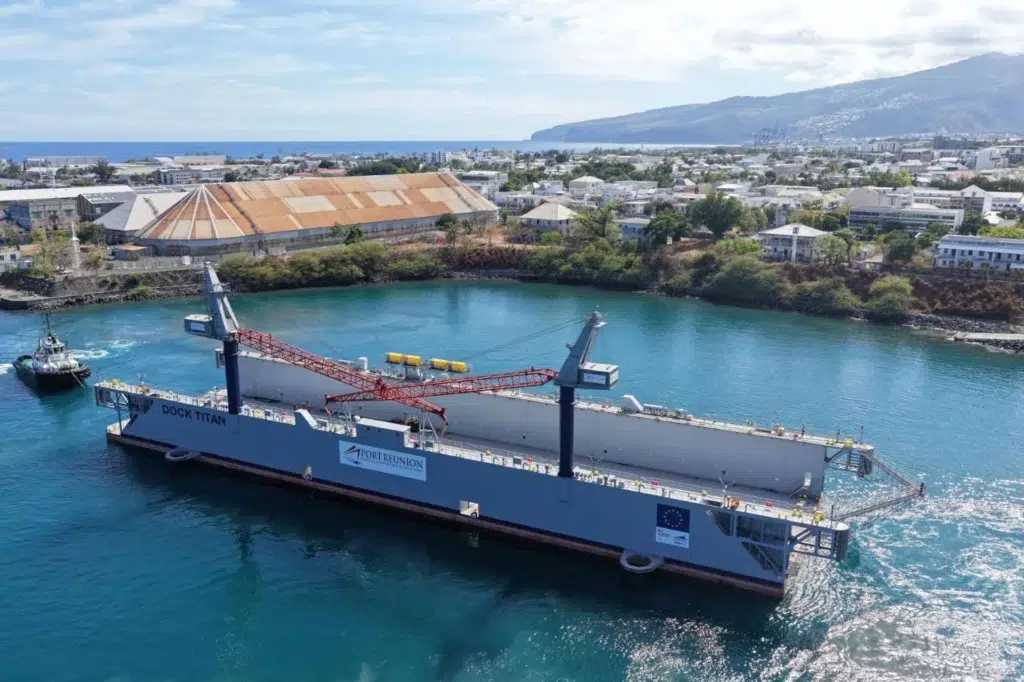
The arrival of Réunion island’s new floating dock
More articles like this can be found in the latest issue of DryDock magazine