

Drydocks World: The evolution of a ship repair yard




An interview with Drydocks World CEO, Captain Rado Antolovic, who explains how a diversified operating model at Drydocks World provides stability even during periods of geopolitical or market disruption
Captain Rado Antolovic holds a PhD and an MBA in Transport and Economics. He was appointed CEO of P&O Maritime in June 2013, CEO and MD – Maritime Services Division of DP World in April 2017 and CEO of Dubai Drydocks World in January 2018. With a career spanning four decades across leading port and maritime industries, he has amassed a wealth of leadership and experience. In his previous roles as CEO and several senior positions, he successfully set up, restructured and managed numerous ports and marine businesses across the globe.
Captain Rado Antolovic, CEO of Drydocks World
Q. Drydocks World has evolved far beyond traditional ship repair and conversions. How do you define the company’s role today within the global offshore energy and EPC landscape?
A. While maintaining its unparalleled position in the global market as a leading service provider to the maritime industry in vessel repairs and conversions, Drydocks World today is best understood as an integrated maritime, offshore engineering and EPCIC platform, not just a shipyard. Its role has expanded from repair and conversion into a broader delivery model that supports the full lifecycle of floating energy and marine assets.
That evolution is visible in the breadth of the portfolio. Drydocks World still performs ship repair, maintenance and life-extension work at scale to clients based globally, but it now also delivers major FPSO upgrades, FSO conversions, FLNG EPC, offshore wind platforms and complex modular fabrication.
The company has built this position over more than 40 years by combining engineering depth, execution discipline and infrastructure scale. It is one of the few yards in the region able to handle the world’s largest ships, offshore rigs and heavy offshore modules within a single integrated environment.
Recent projects show how that role has matured:
- FPSO Baobab Ivoirien for MODEC, with major structural renewal, tank coating, piping renewal and a 15-year life extension.
- FPSO Petrojarl Kong and FSO Yamoussoukro for Eni and Petroci, delivered on accelerated timelines for the Baleine Phase 2 development.
- FPSO Petrojarl Knarr in partnership with Aker Solutions, combining refurbishment and partial electrification for North Sea deployment.
- AMIGO LNG in Mexico, a landmark EPC project that extends DDW’s capability into the world’s largest floating LNG facility.
That matters because the market has changed. Clients are no longer looking only for a yard that can ‘fit the vessel in’. They are looking for a partner that can manage technical complexity, schedule pressure, regulatory requirements and lifecycle economics at the same time.
Drydocks World’s role in the global landscape is therefore to be a one-stop partner for complex offshore delivery. That means bringing engineering, procurement, construction, integration, heavy-lift, load-out, retrofit and commissioning into one framework.
The company’s position is also reinforced by its connection to DP World and Dubai’s logistics ecosystem. That gives Drydocks World access to a global supply chain, port connectivity, customs efficiency and integrated marine services that few competitors can match.
In practical terms, Drydocks World is helping redefine what a modern offshore engineering hub looks like. It is no longer just a place where ships are repaired. It is a place where floating energy infrastructure is designed, integrated, upgraded and launched into the next phase of its life.
The future for Drydocks World
Q. With the South Yard expansion announced last year, the incoming 5,000-tonne crane and growing digital capabilities, what do you believe will define the next generation of shipyards and offshore engineering hubs?
A. The next generation of shipyards will be defined by integration, not just size. Physical capacity still matters, but what really separates winners now is the ability to combine engineering, fabrication, heavy-lift, logistics, digital planning and safety into one operating model.
Drydocks World’s South Yard expansion is a strong example of this shift. The new 75,000 square metre yard has increased fabrication capacity by 40% and added major load-out and berth capability, allowing several large projects to be handled in parallel rather than sequentially.
The incoming 5,000-tonne sheerleg floating crane is another sign of how the market is changing. The next generation of offshore projects is larger, heavier and more modular. That means yards need the ability to lift, position and integrate massive components with precision and confidence.
But the real differentiator is not only the crane or the yard space. It is the system around them. A next-generation hub needs digital planning, integrated execution, safety systems, trained people and supply-chain coordination that all work together.
This is where Drydocks World’s digital transformation becomes important. AI, robotics, digital twins, real-time tracking, predictive maintenance and automated rostering are not add-ons. They are becoming the tools that allow the yard to run at a higher level of precision and reliability.
The same is true for workforce capability. A modern offshore hub needs a highly skilled, diverse and continuously trained workforce that can move between repair, conversion, EPC, renewables and retrofit work. That is why the training centre, digital learning, AR and VR and safety systems matter so much.
Sustainability is also part of the definition. A next-generation shipyard cannot just be productive. It has to be cleaner, more efficient and aligned with global decarbonisation goals. Drydocks World’s carbon footprint reduction, renewable electricity use, waste recycling performance and participation in alliances such as the Global Green Shipyard Alliance (GGSA) and the Maritime Emissions Reductions Centre (MERC) all point in that direction.
In strategic terms, the shipyards of the future will be judged on four things: how much complexity they can handle, how safely they can execute it, how efficiently they can deliver it and how credibly they can support the energy transition.
Drydocks World is positioning itself around exactly those four pillars. The South Yard, the crane, the digital systems, the sustainability agenda and the project portfolio together form a model of what a modern offshore engineering hub should look like.
So, the next generation of shipyards will not simply be bigger. They will be smarter, cleaner, more integrated and more globally connected. That is the direction Drydocks World is already moving in.
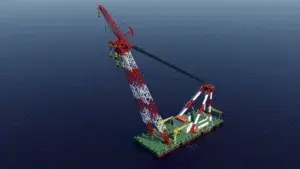
The 5,000-tonne sheerleg floating crane
Q. Oil and gas still remain essential to global energy demand, while renewables continue to scale rapidly. How is Drydocks World balancing these two worlds, and what does that mean for your future project portfolio?
A. Drydocks World’s project portfolio today is still anchored in oil and gas, particularly through repair, maintenance, life-extension and FSO, FPSO, FSRU, FSU conversions/upgrades. That remains a strong and steady part of the business because global energy demand is not disappearing, and operators continue to need existing assets to perform more efficiently for longer.
At the same time, renewables are becoming one of the fastest-growing parts of the portfolio. Drydocks World has already delivered offshore wind platforms for Europe and currently has additional platforms under construction. This shows that the company is not treating renewables as a side story, but as a growing business line with real strategic importance.
The balance between the two is not a contradiction. It reflects how the energy transition actually works in the real world. Oil and gas continue to provide the energy security, capital and infrastructure that support the transition, while renewables expand at pace. Drydocks World is positioned in the middle of that shift.
In oil and gas, the company is focused on making existing assets last longer, operate better and emit less. That includes FPSO upgrades, FSO conversions, rig repairs, scrubber retrofits, ballast water treatment systems and partial electrification projects like Petrojarl Knarr.
In renewables, the company is scaling its ability to deliver large offshore wind converter platforms and grid infrastructure. Projects such as Ostwind 4 in Germany and Norfolk Vanguard East and West in the UK show that the same engineering and fabrication capability used in oil and gas can be applied to clean energy infrastructure at scale.
The result is that the future portfolio will become more balanced. Oil and gas will remain important, but renewables will take a larger share over time as global demand, policy and infrastructure investment continue to shift.
What makes that balance possible is Drydocks World’s integrated EPCIC model. This allows the company to support traditional offshore operators while also scaling into renewable infrastructure without fragmenting delivery capability.
That model is strengthened by the South Yard expansion, heavy-lift investments, digital systems and partnerships with companies such as Aker Solutions and GE Vernova. These relationships allow Drydocks World to move fluidly between sectors rather than being locked into one market cycle.
So, the answer is not that Drydocks World is choosing oil and gas or renewables. It is building a platform that can serve both, while gradually shifting toward a more balanced mix as the market evolves.
Q. Can you provide details of ship repairs carried out in the last four months or so, and has the type of ship repairs changed?
A. We have observed a noticeable increase in LPG carrier and dry cargo vessel repairs compared with previous years, particularly during the first part of 2026. At the same time, demand remains strong for offshore-related work, including drilling rigs and specialised support vessels.
More broadly, the nature of repair activity is also evolving. Owners are increasingly combining routine dry docking with lifecycle upgrades, energy-efficiency improvements, emissions-related retrofits and reliability-focused maintenance programmes.
Q. What will Drydocks World’s focus be this year at Posidonia, and how important has the European market proved?
A. Europe remains one of Drydocks World’s most important markets and continues to be a key source of long-term business. Approximately 35% of our repair business volume comes from European clients, reflecting strong relationships built over many years.
Greece in particular is a strategically important market for us, contributing more than 15% of our annual repair business volume. We have seen steady growth from Greek owners and operators and continue to strengthen those relationships through reliability, technical capability and delivery performance.
At Posidonia this year, our focus will be on demonstrating how Drydocks World is evolving beyond traditional repair activity into a more integrated offshore engineering and EPCIC platform. This includes our expanding capabilities across FPSO upgrades, FLNG infrastructure, offshore wind platforms and decarbonisation-related retrofits.
We also see increasing interest from European clients in lifecycle extension projects, emissions-reduction solutions and integrated engineering support, areas where Drydocks World continues to invest heavily through digitalisation, sustainability and heavy-fabrication infrastructure.
Q. How has the closing of the Strait of Hormuz affected Drydocks World?
A. The closure of the Strait of Hormuz has naturally had an impact on regional vessel movements and parts of the repair market. However, Drydocks World has remained fully operational throughout this period.
Our resilience comes from the diversity of our business portfolio. Alongside conventional repair activity, the yard continues to execute major EPC and offshore engineering projects, including FPSOs, offshore wind platforms and floating LNG infrastructure.
In addition, we continue to receive docking and repair work from vessels operating within the Arabian Gulf region, which has helped maintain operational continuity.
The strength of Drydocks World lies in its ability to balance multiple business lines simultaneously, from repair and maintenance to EPCIC delivery and offshore fabrication. This diversified operating model provides stability even during periods of geopolitical or market disruption.
Read more articles like this in the latest issue of DryDock magazine
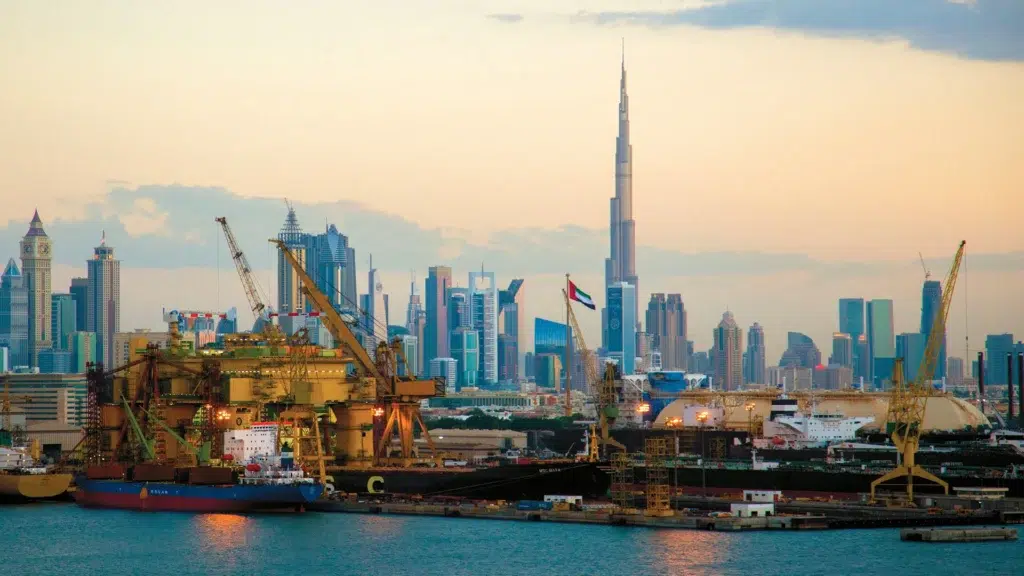
. Drydocks World’s project portfolio today is still anchored in oil and gas