

Building momentum in cruise repairs and major conversions




Fincantieri sees mega yacht and offshore repair work in Trieste to complex cruise repairs and conversion projects in Palermo, and repairs and retrofits for European and Mediterranean operators by Remontowa.
Fincantieri is positioning its Italian repair network for a new cycle of integrated lifecycle projects. Its 2026 cruise repair and conversion activity reflects the increasingly diversified nature of today’s service market, with projects spanning maintenance, repair, class-driven work and more complex cruise conversions.
Across its Italian footprint, Fincantieri is using the specific strengths of its yards to support different segments of demand. While Trieste has historically contributed to cruise repair and refurbishment projects, its 2026 activity has been more focused on mega yacht repair and selected minor offshore work. Palermo, by contrast, has continued to serve as the group’s main platform for cruise ship class maintenance and conversion projects.
Dry dock cycles changing
The mix of work is also a sign of how dry dock cycles are changing. Owners are increasingly looking to combine regulatory and class-driven activities with technical upgrades, hotel improvements and revenue-generating modifications in the same shipyard window. For shipyards, this requires not only dry dock capacity, but also the ability to integrate engineering, procurement, outfitting, hotel refurbishment and class-related work under tight operational schedules.
In this environment, Fincantieri’s service platform is being positioned around the ability to support owners throughout the full lifecycle of the vessel: from standard maintenance and repair to complex upgrade programmes that can extend the commercial relevance of existing tonnage.
Conversion showcase
A recent example is the completion of work on Silver Spirit at Fincantieri’s Palermo yard, a project that illustrates the growing complexity of cruise lifecycle management.
Silver Spirit has a long connection with Fincantieri. The ship was built by Fincantieri in Ancona and delivered in 2009 as the first ship constructed for Silversea Cruises, marking the group’s entry into the luxury cruise segment. The vessel also returned to Palermo in 2018 for a major cruise repair/renewal programme that included the insertion of a 15m mid section, an ultra-luxury cruise conversion project that increased both public areas and suite capacity.
The latest project continued that lifecycle approach, combining structural modifications, additional passenger accommodation, interior refurbishment and public space renewal in a single integrated work package.
The scope included the addition and reconfiguration of guest accommodation, with selected existing suites and cabins redesigned to support a revised onboard layout. The work also included the refurbishment of cabins and public areas, bringing the vessel’s interiors closer to the latest standards of the brand and improving the overall guest experience.
For Fincantieri, the project was not simply an interiors refresh. The cabin work required demolition, structural and outfitting modifications, adjustments to guest area arrangements and the integration of revised technical systems to support the new configuration.
Electrical and HVAC systems were adapted to the revised accommodation and public space layout, while lifesaving appliances and escape calculations were updated to support the revised capacity profile enabled by the conversion.
This type of work is where cruise conversion is becoming more technically demanding. A project that appears guest-facing from the outside – new accommodation, refreshed public areas and upgraded interiors – requires detailed coordination across steelwork, outfitting, safety, class, hotel systems, logistics and the ship’s commercial redeployment schedule.
Beyond hotel refurbishment
The Silver Spirit project also highlights a broader shift in the cruise repair market. Increasingly, major dry dock projects are being used not only to maintain vessels, but to reposition them commercially.
For owners, additional cabins and reconfigured public spaces can improve revenue potential and align older ships with newer brand standards. For shipyards, these projects require a combination of engineering depth and hotel refit execution. The value is created not by a single discipline, but by the ability to integrate naval architecture, class compliance, structural work, interiors, systems and procurement under a constrained dry dock schedule.
In Palermo, that integrated model is particularly relevant. The yard has become a natural platform for cruise repair/conversion work because of its experience with large structural interventions, class maintenance and hotel area refurbishment. The same capabilities used for lengthening, deck additions and public space renewals are increasingly being applied to projects that combine capacity growth with guest experience upgrades.
Silver Spirit is a strong example of this model. The project required Fincantieri to manage a complex package of works that touched both the technical and hotel sides of the vessel, while maintaining the discipline required for a cruise ship operating within a fixed deployment calendar.
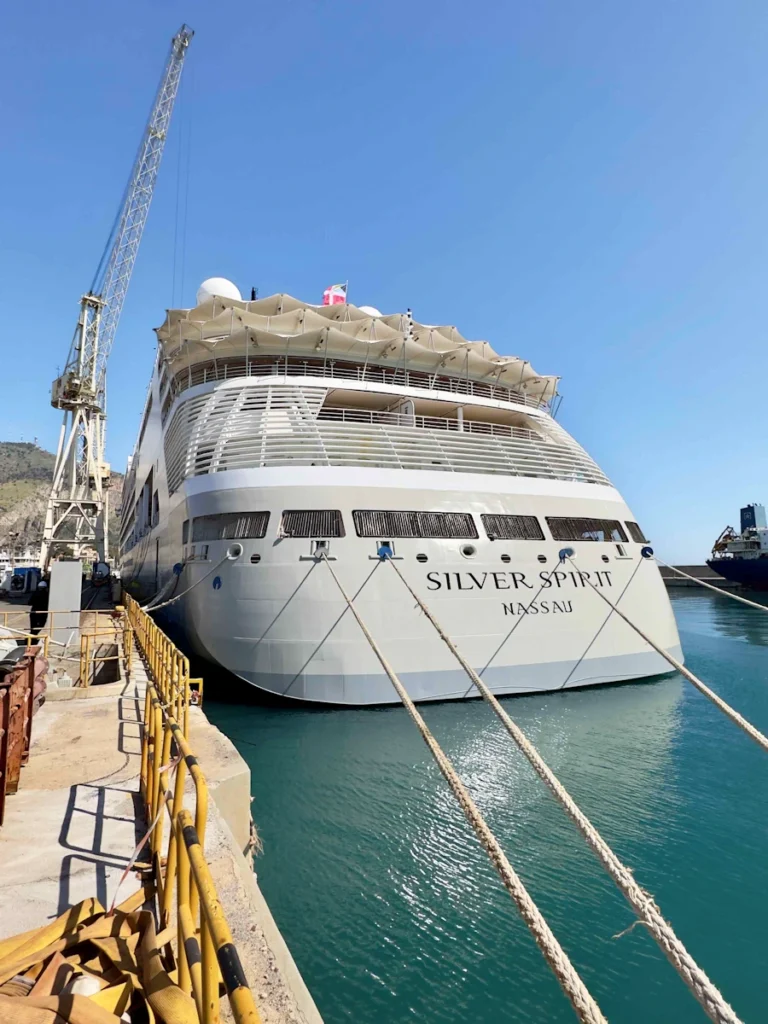
Silver Spirit has a long connection with Fincantieri
A new cycle of major conversions
Looking ahead, Fincantieri sees the major conversion market as one of the most promising areas of cruise ship repair and lifecycle services.
The next wave of work is expected to go beyond traditional refit packages. In addition to systems upgrades and interiors renewal, cruise owners are evaluating larger conversion programmes that can include the addition of new deckhouse areas, expanded accommodation, redesigned public venues and updated technical infrastructure.
“The market is moving toward more integrated dry dock programmes, where class, technical upgrades and hotel improvements are planned as one lifecycle project,” says Massimo Costa, Fincantieri’s Vice President of Ship Repairs and Conversions. “Silver Spirit is a good example of how conversion work can create value while respecting the operational constraints of cruise deployment.”
Fincantieri is exploring different cruise conversion opportunities between 2027 and 2031. These projects would reflect the same market logic seen on Silver Spirit: using a carefully-planned dry dock window to extend the commercial relevance of existing tonnage, increase capacity where feasible and bring onboard products closer to the latest fleet standards.
For Fincantieri, the opportunity is to position ship repair and conversion not as a reactive service business, but as a strategic lifecycle partner for cruise operators. As dry dock planning becomes more complex and slots are secured years in advance, the ability to offer feasible, practical and fully-integrated solutions is becoming a differentiator.
In that context, Silver Spirit is less a one-off project than a marker of where the market is heading: toward cruise conversions that combine class work, technical upgrades, structural modifications and hotel transformation in one coordinated programme.
For cruise owners, the rationale is becoming increasingly clear. In a market where newbuilding slots are increasingly scarce and shipyard orderbooks continue to fill up years in advance, major conversions can provide an effective alternative to fleet renewal through new construction. They allow operators to refresh existing tonnage, increase capacity where technically feasible, upgrade the onboard product and protect asset value, while avoiding the longer lead times and higher capital commitment typically associated with newbuild programmes.
Repairs and retrofits at Remontowa
The first half of 2026 saw Remontowa Shiprepair Yard continue an extensive programme of repairs, retrofits and offshore projects for a broad portfolio of European and Mediterranean operators. The projects completed in Gdańsk covered ferries, chemical tankers, shuttle tankers, offshore support vessels and specialised tonnage, reflecting both the technical diversity of today’s ship repair market and the growing demand for propulsion efficiency upgrades, compliance-driven modifications and operational flexibility.
Across all vessel segments, the repair programmes ranged from routine class renewals and intermediate surveys to complex structural repairs, propulsion overhauls, offshore mobilisation projects and emergency repairs carried out under demanding operational schedules. Particular focus remained on propulsion reliability, cargo-handling systems, hull preservation and upgrades supporting evolving environmental and operational requirements.
Ferries and RoPax
Ferry and RoPax vessels once again formed a major part of the yard’s repair portfolio, particularly for operators active in Northern Europe and the Baltic Sea trades.
Several Stena Line ferries underwent extensive repair and modification programmes in Gdańsk. On Stena Flavia, the docking programme focused on propulsion efficiency and underwater equipment. Following inspection in dock, the damaged silicone coating in the underwater hull area was replaced with antifouling protection due to schedule constraints. The vessel also received new Berg propeller blades on both shaftlines, while work on stabilisers and bow thrusters included bearing repairs, welding and replacement of hubs and blades.
The class renewal of Stena Jutlandica developed into one of the most extensive ferry projects of the period. A major structural renewal programme covered large sections of the third deck, requiring steel replacement work extending almost the full length of the vessel. Extensive preparatory work had already been initiated during the vessel’s voyage prior to arrival at the yard, enabling immediate commencement of steel repairs upon docking. The programme also included repairs to the stern ramp structure, overhauls of steering and stabiliser systems, renewals of MGPS and ICCP systems, ballast tank piping renewals, and extensive accommodation area reinstatement work following structural modifications.
DFDS ferries return
DFDS ferries also returned to Remontowa for another series of repair projects, continuing a long-standing cooperation between the operator and the yard.
The repair programme on Optima Seaways combined underwater works with structural and machinery maintenance. The vessel underwent stabiliser works, bow thruster inspections and shaft-seal renewals, while steel renewals were carried out in ballast tanks and vehicle decks. Additional piping renewals and overhaul of generators, motors and cooling systems formed part of the technical scope. The vessel also received a replacement speed log system installed in a dedicated hull fairing arrangement.
On Ark Futura, the focus shifted toward cargo-handling systems and structural repairs. The project included replacing winches for both the stern ramp and lifeboat systems, overhauling the stern thruster and replacing propeller blades. Steel repairs were carried out in cargo areas, fuel tank regions and funnel structures, while electrical teams repaired navigation-related equipment and auxiliary systems.
Another DFDS ferry, Victoria Seaways, underwent propulsion-efficiency upgrades, including installation of a specialised energy-saving cylinder arrangement on the propeller and rudder system, combined with replacement of propeller blades optimised for lower fuel consumption. The scope further covered stern-ramp hydraulics, hull modifications, shore-power preparation work and installation of new firefighting piping systems.
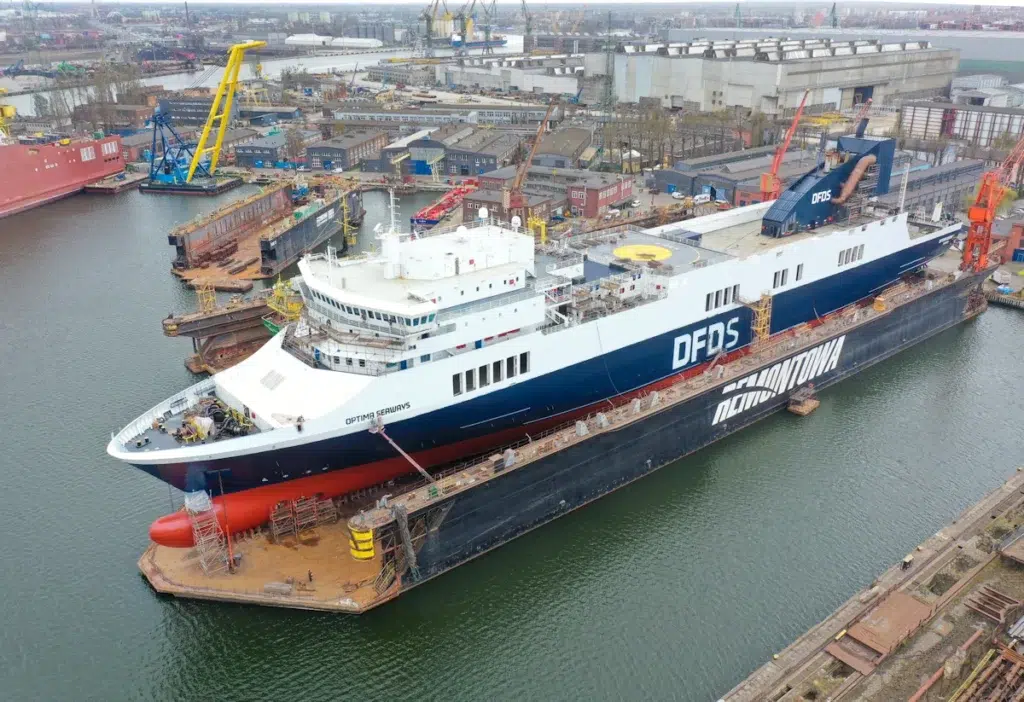
The repair programme on Optima Seaways combined underwater works with structural and machinery maintenance
TT-Line vessel upgrades
TT-Line vessels represented another important part of the ferry segment. The repair programme for Marco Polo was divided into two separate yard stays to accommodate operational requirements while maintaining service continuity. Structural repairs focused primarily on internal and stern ramps, with extensive steel renewals and reinforcement work carried out both onboard and ashore. Additional works included scrubber system maintenance, insulation renewals, fuel tank repairs and piping system overhauls.
Meanwhile, Huckleberry Finn underwent a broad repair programme combining preservation work with structural and mechanical repairs. Large-scale coating was carried out on the superstructure, funnels and lifeboat-support structures, while steering systems, rudders and shaftline arrangements underwent overhaul and inspection. One of the technically demanding tasks involved replacing a boiler tank, requiring the creation of a technological opening in the funnel structure.
Read more articles like this in the latest issue of DryDock