


Options for marine global decarbonisation






Retrofit – where does energy efficiency retrofitting stand in the light of ongoing regulatory uncertainty, commercial pressures and fuel cost increases, asks Jason Stefanatos, Global Decarbonization Director at DNV
Jason Stefanatos, Global Decarbonization Director at DNV
Today, commercial pressures, the rise in the fuel price and both regional and international regulations have led to energy efficiency (EE) and retrofitting for enhanced fuel performance becoming important once again. EE can help save costs today, while reducing emissions and building the foundation for the wider roll-out of new fuels.
Regulatory frameworks were the initial force shaping shipping’s decarbonisation journey. The FuelEU Maritime, the EU Emissions Trading System (ETS) and the IMO’s Carbon Intensity Indicator (CII) set the current requirements, and the industry has been working towards the ultimate destination of net zero.
Immediate decarbonisation benefits even in uncertain times
However, the recent adjournment of the IMO’s Net-Zero Framework (NZF) vote has unsettled expectations, raising questions about timelines, compliance costs, and whether regional regulations will proliferate in the absence of global alignment.
For DNV, there has never been a ‘silver bullet’ solution but a range including fuels, energy efficiency, onboard carbon capture, digitalisation and others. EE especially has the potential to provide shipowners with an immediate and cost-effective route to emissions reductions, a compliance tool that can also be a competitive advantage, reducing operating costs and enhancing resilience to fuel price volatility.
Examples of this are wide and varied, starting from low-hanging fruit, such as slow steaming and weather routing, to more technical measures, such as hull and propeller maintenance, machinery optimisation and digital performance management. Going beyond this – and requiring a higher degree of investment – wind-assisted propulsion systems (WAPS) can drive further gains.
There is a wide spectrum of retrofits, from the day-to-day to the firsts that can set the direction for the industry more broadly. To focus in on one and the challenges and benefits at the ‘top end’ of the retrofit scale can be illustrative.
Decarbonisation retrofit at the top end
The world’s first methanol conversion project for a mega-container carrier was completed at CHI‑Shanghai’s yard in September 2025. At nearly 400m in length and with a capacity of 20,000 TEU, the seven‑year‑old COSCO Shipping Libra became the first ship of its kind to be retrofitted to run on methanol.
The general design was developed by MARIC, while CHI Shanghai carried out the detailed engineering and served as EPC contractor. The scope included conversion of the ship’s MAN B&W 11S90 main engine and two of its four Wärtsilä auxiliary engines to dual‑fuel operation.
Fuel retrofits must be designed with flexibility in mind. At CHI Shanghai, this translated into preserving the original fuel systems where possible, ensuring automation compatibility and minimising cargo‑capacity loss. The vessel’s fuel system, designed only for conventional fuels, required fundamental changes to enable methanol operation across propulsion, auxiliaries, storage and safety systems.
In parallel, new methanol fuel tanks with a total capacity exceeding 15,000 cubic metres were installed forward of the engine room, together with new fuel preparation and supply systems. To accommodate the methanol tanks and systems, the capacity of the vessel was reduced by just over 450 TEU, which required a reassessment of the vessel’s deployment and network planning.
Delivering as a retrofit rather than a newbuild added complexity: the new systems had to be integrated into confined spaces, requiring innovative construction sequences and tight interface management between suppliers. For example, the original plan envisaged fabricating the methanol fuel tank and preparation room as a single integrated block, to be lifted and installed on board. In practice, this proved impractical, so instead major components were assembled at ground level before integrating them into the vessel.
The total yard stay for COSCO Shipping Libra of 108 days included eight days of sea trials. When the sister vessel COSCO Shipping Gemini entered the yard later the same year, the same core team was able to apply lessons learnt from the first project. This resulted in completing the retrofit in just 90 days, demonstrating clear efficiency gains.
This project became a reference point for managing complexity at scale. CHI Shanghai has since applied similar methodologies to other projects, including multi‑vessel methanol retrofits for Seaspan and potential LNG retrofits for MSC and COSCO Shipping. So while individual projects differ, the underlying approach, such as detailed design ownership, phased construction and intensive integration testing, remains consistent.
Overall, the significance of the project lies in what it enables. By converting a technically demanding megaship, the project demonstrated a credible pathway for large‑scale methanol retrofitting, as well as accelerating the development of repeatable processes at the yard, and for the owner, real‑world insight into both the conversion and the operations of the vessel.
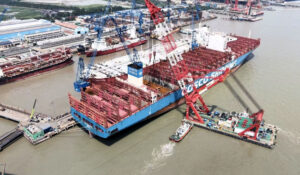
COSCO Shipping Libra became the first ship of its kind to be retrofitted to run on methanol
A vital puzzle piece to decarbonisation
Decarbonisation of shipping is a complex puzzle with many different solutions. Energy efficiency is a vital part of this and will be crucial in helping the maritime industry reach its ambitious goals.
Fleet decarbonisation strategies and plans can reduce and manage decarbonisation risks for the existing fleet. A three-step approach can be applied when developing such strategies and plans:
- Define GHG trajectory and goals: This should build on assessing both regulatory (e.g. IMO, EU) and commercial drivers (e.g. Poseidon Principles, Sea Cargo Charter) for decarbonisation along the timeline, deciding whether the fleet should meet the minimal regulatory compliance requirements or pursue more ambitious GHG targets, with opportunities for also offering green transport.
- Assess pathways for meeting GHG trajectory and goals: Using fleet simulation tools (e.g. DNV’s Pathway and optimisation models, different pathways available for meeting the GHG trajectory and goals are identified, accounting for the current fleet baseline and gaps. All promising compliance options relevant for the fleet, including EE measures, fuels, onboard CCS, pooling mechanisms, should be considered.
- Develop fleet decarbonisation strategy and plan: Select one pathway based on step 2. The chosen pathway should be robust, consider various uncertainties and GHG risks (e.g. regulatory developments, technological progress, fuel supply, market developments, charter requirements, access to financing, etc.), and be aligned with any existing company strategy.
Energy efficiency retrofit uptake
EE measures are widely implemented across the global fleet, in particular measures with low investment cost and short payback time. However, uptake varies significantly depending on vessel type, commercial contract type and vessel age.
Shipowners should prioritise measures based on cost efficiency and other aspects such as technical maturity, complexity, safety and reliability, lack of experience, and crew training needs. Survey results indicate that operational measures have lower barriers than technical measures.
To look at a few common examples:
Energy-efficient lighting systems can be installed on all vessel types and ages, but total energy consumed for lighting on a normal merchant vessel is estimated to be 0.25% to 5% of the total electrical power, up to over 10% for cruise and passenger vessels. This can be reduced through low energy halogen lamps, fluorescent tubes and LEDs in combination with electronically-controlled systems for dimming, automatic shut off, etc., with the added benefit that most energy-efficient lighting systems have an equal or longer lifetime than normal lighting systems and can also reduce maintenance hours and the need for spare parts.
Optimisation of cargo handling systems and cargo operations is applicable for several vessel types and their respective cargo operations. Options include installing variable frequency drives (VFDs) for pumps and cranes or using advanced insulation and heat recovery systems for cargo heating and cooling. Monitoring and control systems can further enhance efficiency by optimising energy use in real time. These are especially of interest in the tanker segment.
We should also not forget the bulbous bow retrofit. In several segments it is common practice and has already been applied to several thousand vessels, but primarily for boxships. DNV has already delivered retrofits to 23% of the relevant standard designs of the world’s container carrier fleet (500–15,000 TEU). There are still possible efficiency gains of up to15% if the vessel design does match to the whole operating range of the vessel and the common use of light draft conditions and slow steaming.
There are many more examples available and assessed for CAPEX, OPEX, implementation time, segment applicability and regulatory impact in the DNV Energy Efficiency white paper.
Energy efficiency today and in the future
Over the longer term, energy efficiency will also help to drive the large-scale emergence of carbon-neutral fuels. Future fuels will be more expensive than conventional versions, so combining these with EE measures will significantly reduce costs, improving the business case for shipowners adopting these fuels, and encouraging greater uptake.
There is already a range of innovative, practical and effective technologies available today which can increase the energy efficiency of vessels, decrease net energy input and fuel demand and drive significant reductions in emissions. At the same time, they may potentially reduce the emission costs and penalties from regulation (CO2 tax).
Finding the optimal combination of measures and technologies is challenging, but when done effectively, it can enable shipowners to not only meet short- and mid-term regulatory requirements but also to gain a competitive edge for profitable operations well into the 2030s and 2040s.
More articles like this can be found in the latest issue of DryDock magazine