

Rethinking onboard maintenance





Ewout Bosman, PPG Global Marine Sea Stock Segment Director, Protective and Marine Coatings, explains why a straightforward coating maintenance routine can improve consistency and asset protection.
Onboard maintenance has long been recognised as an essential part of protecting vessel integrity between dry dockings. Yet the environment in which maintenance is performed has changed significantly. Today’s crews operate under increasing time pressure, vessels are expected to remain in service longer between scheduled maintenance periods and the industry continues to face persistent workforce shortages. For instance, the latest BIMCO/ICS Seafarer Workforce Report estimates that the global shipping industry is currently short of more than 39,000 officers. To meet future demand, the industry will need an additional 22,747 officers and 8,475 ratings or non-officer crew members entering the workforce each year through 2030.
These changing conditions are prompting operators to evaluate maintenance systems based on how consistently repairs can be executed on board, how efficiently products can be managed and how maintenance practices can be standardised across fleets.
This shift is driving renewed interest in maintenance solutions that simplify routine repairs without compromising corrosion protection.
Onboard maintenance begins between dry dockings
Every voyage exposes a vessel to saltwater, ultraviolet radiation, changing temperatures and mechanical wear. Even minor coating damage can quickly develop into corrosion if left untreated, increasing repair requirements during the next scheduled dry docking and potentially affecting long-term asset integrity.
Routine inspections and localised repairs remain among the most effective ways to preserve protective coating systems and extend service life. Industry data shows proactive maintenance programmes can reduce emergency repair costs by 20-30%. Across an entire fleet, improvements in routine maintenance can translate into significant savings while extending component life and improving operational reliability.
Despite its importance, onboard maintenance rarely happens under ideal conditions and is seldom the primary purpose of a crew’s time on board. Instead, crew members perform repairs between operations, inspections, equipment maintenance and countless other responsibilities. They are professional seafarers. Every minute spent preparing coatings, searching for products or correcting application mistakes is time they cannot spend on other operational priorities. Maintenance products should fit into that reality rather than add unnecessary complexity.
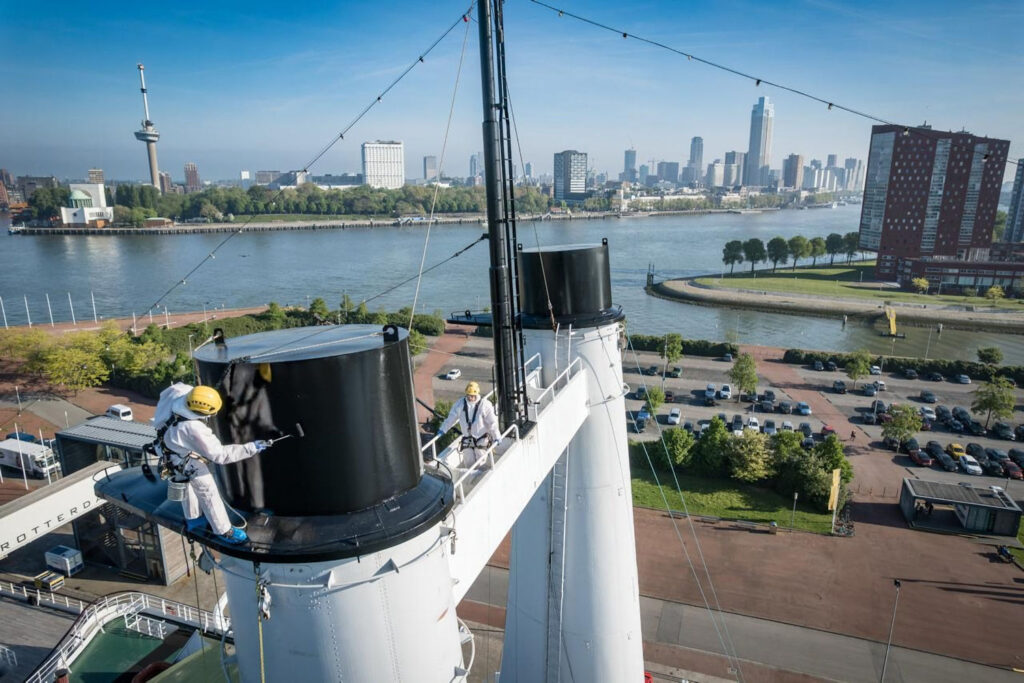
Onboard maintenance rarely happens under ideal conditions
Why simplicity matters
Two-component coating systems are the traditional solution for many applications where maximum durability, chemical resistance and long-term protection are required. However, preparing a two-component coating requires crews to measure separate components accurately, follow specific mixing ratios and work within a limited pot life before the coating begins to cure. In practice, those tasks often take place inside confined paint lockers while crews balance other operational priorities. Mixing frequently happens by estimation rather than precision. Preparing too much coating creates unnecessary waste. Preparing too little interrupts the repair. Every additional step creates another opportunity for inconsistency.
Ready-to-use one-component coatings simplify that process. Crews prepare the surface, stir the coating and begin application immediately without measuring separate components or managing pot life. Fewer preparation steps reduce opportunities for mixing errors, while helping standardise maintenance practices across vessels.
That maintenance consistency across dozens or even hundreds of vessels can directly influence long-term asset performance and maintenance costs. Simplifying coating preparation and application helps reduce variability between crews operating in different regions and under different conditions. Standardised maintenance practices also simplify training, product forecasting and inventory management, while giving operators greater confidence that repairs are being completed consistently throughout the fleet.
Simplifying inventory management for onboard maintenance
Open the door to almost any vessel’s paint locker and you’ll find a variety of primers and topcoats, many of which require separate hardeners and thinners before they can be applied. Managing, storing and mixing these additional components adds complexity to onboard maintenance and consumes valuable storage space.
Simplifying maintenance coatings can reduce the number of products crews need to manage, improve inventory control and minimise partially-used materials that ultimately require disposal. The result is a more efficient maintenance process that allows crews to spend less time organising products and more time completing repairs.
Supporting sustainability
Environmental performance is becoming another consideration in routine maintenance decisions. Operators increasingly evaluate coatings for corrosion protection and for waste generation, volatile organic compound (VOC) emissions and inventory efficiency. Ready-to-use one-component coatings can help reduce leftover mixed material that ultimately requires disposal, while low-VOC formulations support evolving environmental expectations.
Innovation for better onboard maintenance
Advances in onboard maintenance extend beyond coating formulation. Digital inventory management tools are enabling operators to monitor coating consumption across fleets, optimise seastock inventories and identify recurring maintenance trends before they develop into larger asset integrity issues. Improved visibility allows operators to maintain appropriate stock levels while reducing unnecessary purchases and excess inventory.
Training remains equally important. Standardised seastock programmes that combine classroom instruction with practical application help reinforce best practices in corrosion prevention, surface preparation and coating application, improving consistency regardless of crew experience. For example, PPG supports shipowners through global seastock training programmes. Having delivered more than 200 crew training sessions worldwide to date, these programmes combine classroom instruction with hands-on practice using the same products and equipment crews use on board.
PPG‘s One Range portfolio reflects this approach by offering ready-to-use one-component coatings, including water-based, low-VOC and fast-drying formulations designed for onboard maintenance. The portfolio eliminates mixing errors, streamlines application and simplifies paint locker inventory by reducing the number of separate components crews must manage. The portfolio complements, rather than replaces, traditional two-component coating systems by providing an alternative for maintenance applications where ease of use, inventory simplification and reduced waste are key considerations.
Together, simplified coating systems, structured training and digital maintenance tools enable a more standardised approach to onboard maintenance that supports both operational efficiency and long-term asset protection.
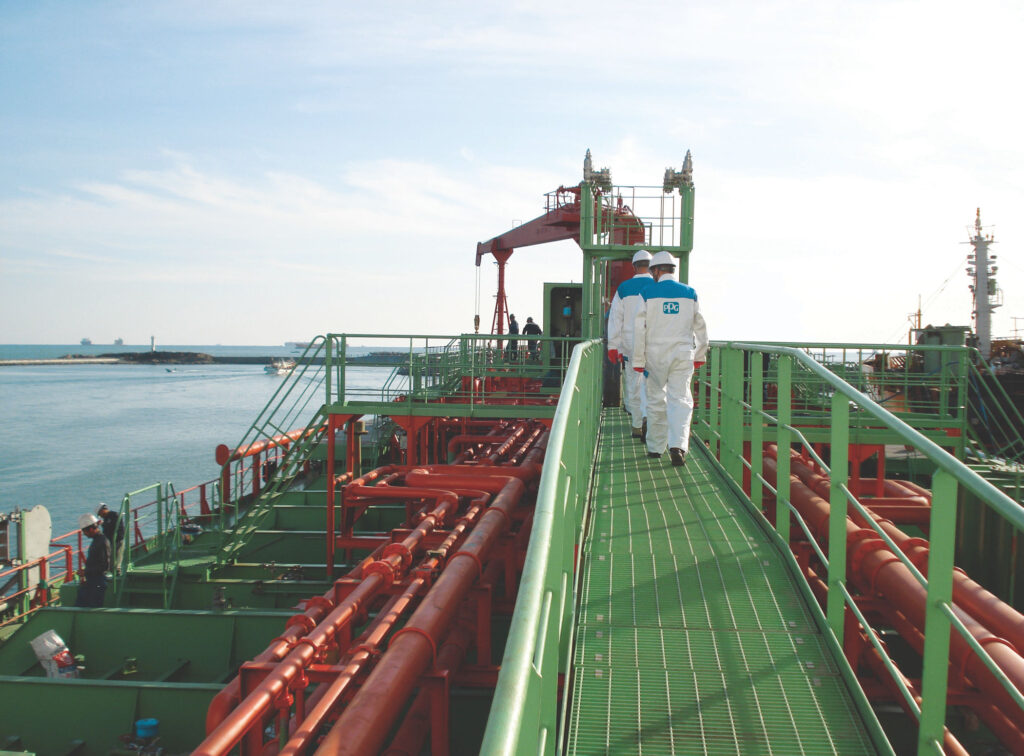
PPG supports shipowners with onboard maintenance through global seastock training programmes
Looking ahead
The future of onboard maintenance will not replace established coating technologies. High-performance two-component systems will continue to play a critical role in protecting vessels operating in demanding environments.
However, maintenance strategies are evolving. As operators seek greater consistency across global fleets, coating selection will increasingly be evaluated not only on corrosion protection but also on ease of application, maintenance standardisation, inventory efficiency and lifecycle performance. For routine onboard maintenance, simplifying the maintenance process can improve execution, reduce variability and help operators protect assets more effectively between dry dockings.
Ewout Bosman is PPG Global Segment Director for Marine Seastock, Protective and Marine Coatings, where he leads international initiatives focused on sustainable maintenance strategies for the maritime industry. With almost two decades of experience in the coatings industry, Bosman brings deep expertise in segment strategy, product and portfolio management and innovation across global markets.
Read more articles like this in the latest issue of DryDock magazine