

Amazing inspection drones are taking off in maritime



Industry ‘disruptors’ constantly tout new technologies in the hope that they have found the next big thing that will drive real, meaningful change. Drones, it seems, have fallen into the successful category when it comes to inspection technologies in the maritime sector, says Eloise McMinn Mitchell, Vertical Marketing Manager, Flyability.
Inspection drones have evolved rapidly in the past 10 years, growing from mobile camera platforms to critical data-gathering tools with a growing list of applications. These drones offer multiple types of data collection while prioritising safety and efficiency for their users. This article explores how drones are reshaping maritime inspections and how the industry is reacting.
What is a maritime inspection drone?
While the standard inspection drone is typically used for photography, industrial inspection drones are a completely different type of unmanned aerial vehicle or system (UAV/UAS). They’re designed to gain access to complex or unsafe environments to give inspectors more information than they can conventionally or safely get.
The maritime sector has seen a rise in inspectors using drones as remote inspection technologies for class surveys. Initially, drones could be used for close visual inspections, but new developments, including the integration of ultrasonic thickness gauges, mean drones can now be used to gather more data without needing scaffolding – cutting hours of work and days in dry dock with faster, safer inspections. Drones are inspecting various types of vessel and their storage facilities, including ballast tanks, oil tanks and cargo holds.
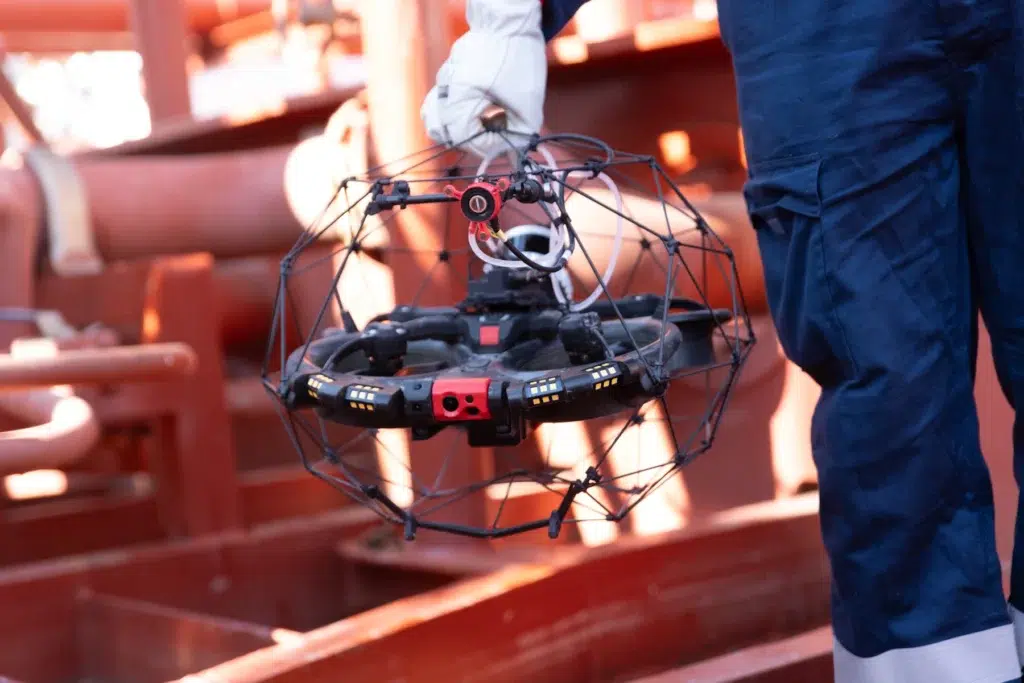
The Elios 3 is portable and light, meaning it can be easily transported
Flyability leads the charge
One of the biggest names in maritime inspection drones is Flyability – the Swiss scale-up behind the Elios 3 platform. Backed by over 10 years of R&D, the Elios 3 is Flyability’s third generation of a unique, collision-tolerant drone that uses biomimicry and modularity to adapt to different inspection environments.
As inspection drones go, the Elios 3 offers a broad range of benefits. It starts with the drone’s design: a flexible, collision-tolerant cage and impact-recovery firmware mean the drone can be flown in confined spaces and recover from making contact with its surroundings without pilot intervention. This, combined with its ability to fly in GPS-denied environments, makes it a leader for safely gaining insights into inaccessible locations – from underground mines to inside wind turbines and now ship hulls and tanks. During a flight, pilots can navigate using the drone’s 4K camera while using the thermal overlay to spot hotspots, and in cases of extreme dust the pilot can swap to the 3D LiDAR view as the drone simultaneously scans and creates a 3D model of its environment that enables navigation when the visual feed is disrupted. The integration with the LiDAR data also enables precise localisation of defects and UT (ultrasonic thickness) measurements within a digital twin of the vessel, allowing for repeated inspections of the same defects and streamlining the generation of reports.
The Elios 3 was designed with long-term adoption in mind. For that reason, the inspection drone features a modular payload bay to support new sensors that Flyability regularly releases, allowing early adopters of the technology to benefit from the latest developments. Now, the Elios 3 can carry explosive gas sensors, radiation detectors and, most relevant to the maritime sector, an ultrasonic thickness payload created in partnership with UT measurement experts Cygnus Instruments. This payload is what has opened the door to this drone being a viable tool for the maritime sector, offering the ability to collect the data necessary for class surveys without scaffolding or rope access, even inside ship hulls.
Probe types and drones
Flyability’s Elios 3 UT is one of the only inspection drones that can be used for non-destructive testing. The UT payload comes with a cleaning module to remove light rust/dust before taking a measurement, as well as a syringe for remotely deploying couplant to ensure smooth sound transmission. The probe head uses magnets to stick to the test surface, with different probe head shapes available according to the size and position of the material.
The partnership between Flyability and Cygnus Instruments has been the key factor behind the success of this payload, as its design was tailored by Flyability’s drone expertise and Cygnus Instruments’ 40+ years of experience in ultrasonic testing. Together, they created two probes for the drone: a single crystal and a twin crystal, including sub-categories of the twin crystal probes. The twin crystal and single crystal probes were designed to offer a broad range of measurement capabilities according to the test material, depending on corrosion levels and the presence of coating.
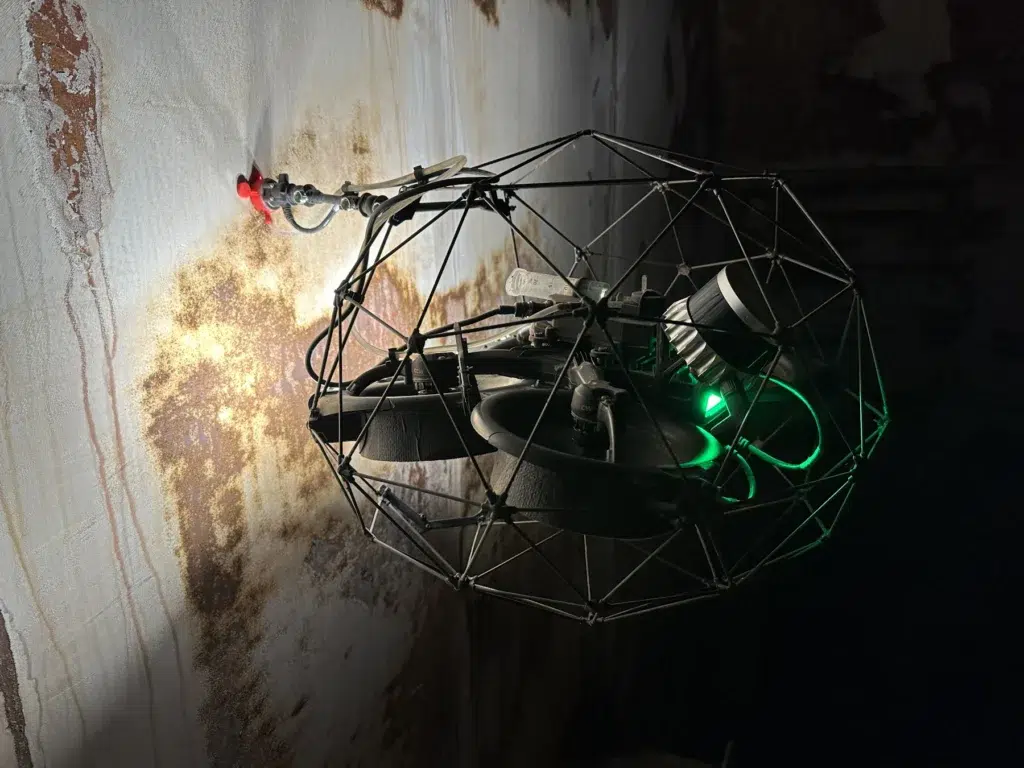
Using a probe head and magnet, the Elios 3 drone attaches to surfaces for UTM
Class society view
Any tool could be used for data collection for a class survey, but the results may not be accepted by the class society. For that reason, Flyability put industry acceptance at the core of its maritime strategy. The company submitted its technology to rigorous testing by multiple class societies, including the American Bureau of Shipping (ABS).
ABS set the inspection drone to work in multiple environments to test the quality of its results, including ultrasonic thickness measurements in tankers, chemical carriers and bulk carriers. During these assessments, the drone was found to “quickly, safely, and efficiently access spaces that humans can’t reach and therefore, the need for scaffolding, rope access, and rafting is eliminated.” The safety implications are huge, as all traditional means of access carry inherent risks to inspectors, alongside being costly and time-consuming.
Following extensive assessments over several years, ABS updated its Guidance Notes on the Use of Remote Inspection Techniques to include drones – a clear signal of the growing acceptance of UAVs as a method of collecting data for class surveys. In an interview with Flyability, ABS team members said they saw “strong potential for this type of technology and application to become increasingly common. The demonstrated benefits in terms of safety, accessibility, and potential cost and time savings align with the industry’s ongoing efforts to improve efficiency and safety.”
Making maritime inspection drones centre stage
In February of 2026, Flyability hosted the Maritime Drone Days in Athens, Greece to put the Elios 3 UT inspection drone on stage and invite industry professionals, regardless of their familiarity with drone technology, to see what the Elios 3 UT can do and what the future holds. Over two days, more than 140 people gathered to hear from a plethora of guest speakers, including representatives from ABS, Bureau Veritas, Lloyd’s Register, IACS, Cygnus Instruments, TotalEnergies and more. On the second day, thanks to permission from the Hellenic Navy, Flyability hosted training for attendees with the Elios 3 and its UT payload aboard the iconic Georgios Averof, a 100-year-old armoured cruiser that is also a floating naval museum. With exclusive access for the day, event attendees tried their hands at piloting the drone through the space, including with the tethered power unit, which enables unlimited flight time by replacing battery units with a tethered power cable.
An international event like this, including its high attendance and prestigious guest speakers, signals an industry-wide shift towards drone adoption. Despite the Elios 3’s UT payload being just three years old, it has already been approved by two class societies, and more than eight class societies accept data from inspection companies that use the Elios 3.
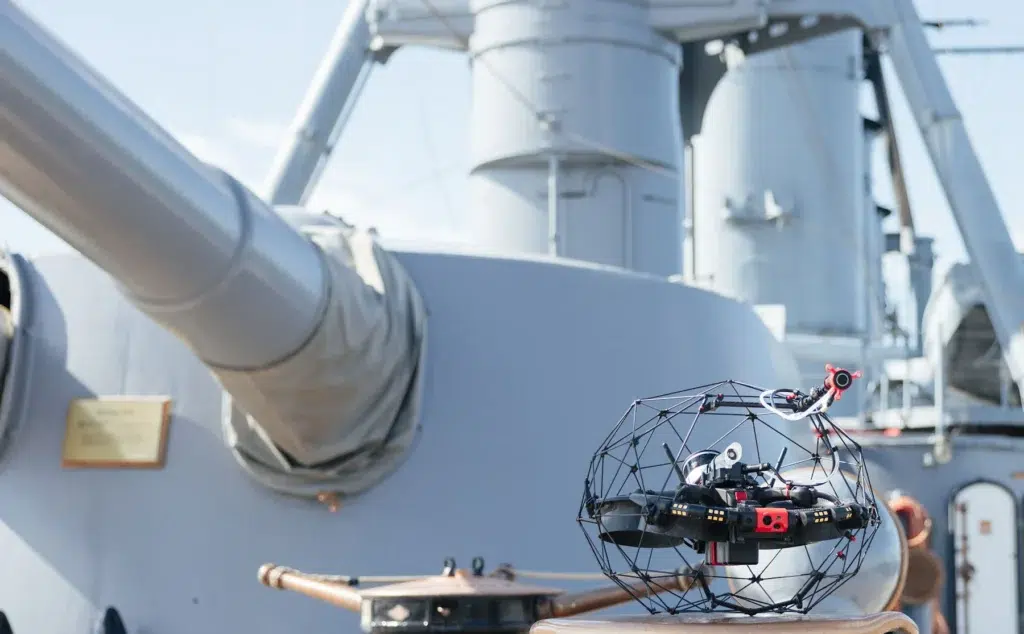
The Elios 3 aboard the Averof in Athens
Continued advances
The unstoppable growth of drone technology – paired with the rising capabilities of AI and automation features – means that this technology will only get better with time. Alongside reducing safety risks to inspectors from work at height or in confined spaces, case studies show that this technology can save as much as $600,000 in cargo tank inspections. Drone manufacturers are also investing in more automation capabilities to ensure ease of use for pilots and to reduce the skill barrier for flying drones. Flyability itself launched a Smart Return-to-Home feature that enables the drone to autonomously fly back to the pilot at the end of a mission, as well as to automatically return to the exact same point when resuming an inspection, to ensure total data coverage. More automation features are promised by Flyability, and other drone manufacturers declare the same for their products.
When the choice is between hundreds of work hours on scaffolding or the headache of organising safe rafting inside ship hulls, and an inspection drone that can be deployed in minutes and complete the work in days instead of weeks, it’s not a question of if drones have a place in the maritime sector – but how quickly they’ll become the norm.
Read more articles like this in the latest issue of DryDock magazine