








Cruise vessel repairs and maintenance at Damen, Wärtsilä reduces engine overhaul time, a combined rudder trunk and shaft line repair in Greece by MarineShaft, an SGS underwater ALS cruise ship repair and a cruise first for Jotun.
April saw the state-of-the-art polar expedition cruise vessel Le Commandant Charcot arrive at Damen Shiprepair Brest for its five-year survey and upgrade work.
Ponant’s 150m-long vessel is designed for high-latitude polar expeditions in the Arctic and Antarctic. It features a PC2 hull able to break ice up to 2.5m thick and can host up to 270 passengers in highly comfortable accommodation.
Safe exploration
During its time at the Brest yard, Le Commandant Charcot underwent a range of work including blasting and painting of the hull. To enable it to withstand regular contact with ice, an Inerta coating was applied beneath the waterline. To ensure the vessel’s ability to operate in remote regions, close attention was paid to checking and maintaining safety-critical systems and equipment. This included the vessel’s lifeboats, helicopter lifting platform and support systems for its 16 Zodiac expedition boats.
Tailored maintenance for Arctic conditions
A further area of focus was Le Commandant Charcot’s propulsion equipment. The yard undertook a complete overhaul of its Azipod thrusters, polishing of its ice-strengthened propellers and servicing of bow thrusters – essential in ensuring the vessel’s ability to manoeuvre in icy waters.
Additional work included maintenance of the vessel’s stabilisers to ensure passenger comfort in rough seas, and maintenance of the LNG propulsion system.
“Arctic cruise vessels like Le Commandant Charcot operate in some of the harshest conditions on Earth,” says Ronan Scolan, Commercial Manager at Damen Shiprepair Brest. “Taking care of such a ship requires a shipyard with the right facilities, craftsmanship and understanding of polar-class vessels. At Damen Shiprepair Brest, we combine deep technical expertise with a full lifecycle approach, working closely with our clients to ensure their vessels remain safe, efficient and ready for the next expedition.”
On completion of the project, Le Commandant Charcot departed the yard on April 30, bunkering LNG in the port of Brest before sailing to Reykjavik to begin its next Arctic expedition.
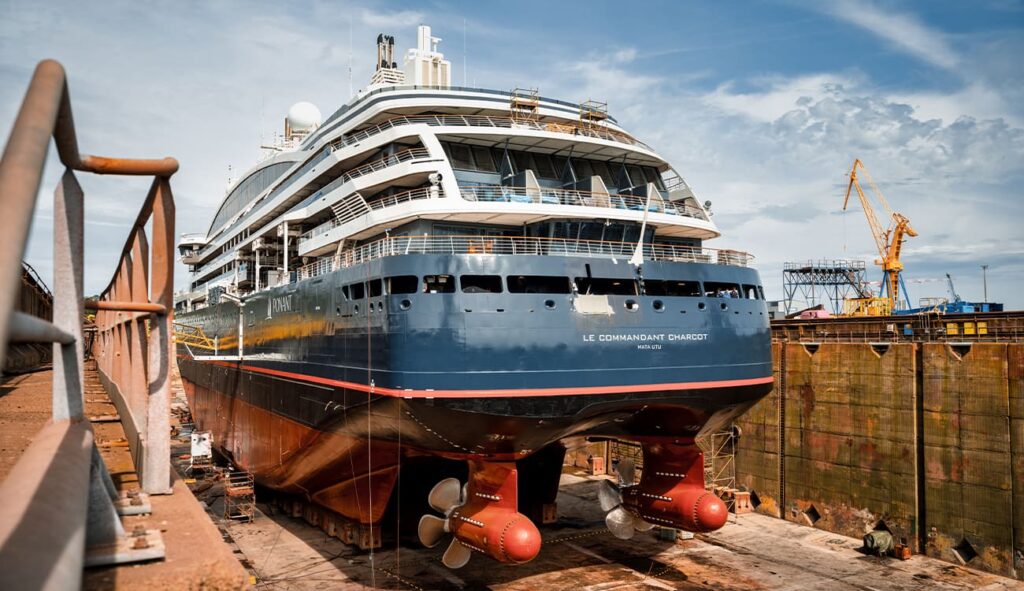
The yard undertook a complete overhaul of Le Commandant Charcot’s Azipod thrusters
An unusual survey
Earlier this year, Damen Shiprepair Rotterdam’s Botlek yard welcomed AIDA Cruises’ 253m cruise ship AIDAmar for its annual bottom survey. What made this project different was that the vessel arrived with around 2,000 passengers still on board.
While the yard’s technical team carried out the inspection in dry dock no. 6, guests were given a rare front-row view of a working shipyard. A viewing platform was set up, along with an exhibition on the history of Damen Shiprepair Rotterdam, and covered access to buses for day trips across the Netherlands.
Managing a safe, controlled operation with passengers on board required meticulous planning and close coordination with AIDA Cruises. The yard took great care to ensure that everyone could move freely and safely throughout the visit, something it is proud to have delivered.
Simultaneous arrivals
There were also unusual scenes in the port of Rotterdam recently when two large cruise ships arrived simultaneously for maintenance work.
Holland America Line’s almost 300m-long Rotterdam docked in the Botlek yard’s 405m x 90m dry dock for a five-year survey. The work carried out on the vessel included maintenance on both azimuth thrusters and a full repaint of the hull – both above and below the waterline.
Meanwhile, TUI Cruises’ 295m Mein Schiff 3 entered Damen Shiprepair Rotterdam’s Schiedam yard, where it had a new steel plate installed on its port side bow – a job that was undertaken together with colleagues from Damen Shipyards Galati. Additionally, the vessel underwent painting work and a minor thruster overhaul.
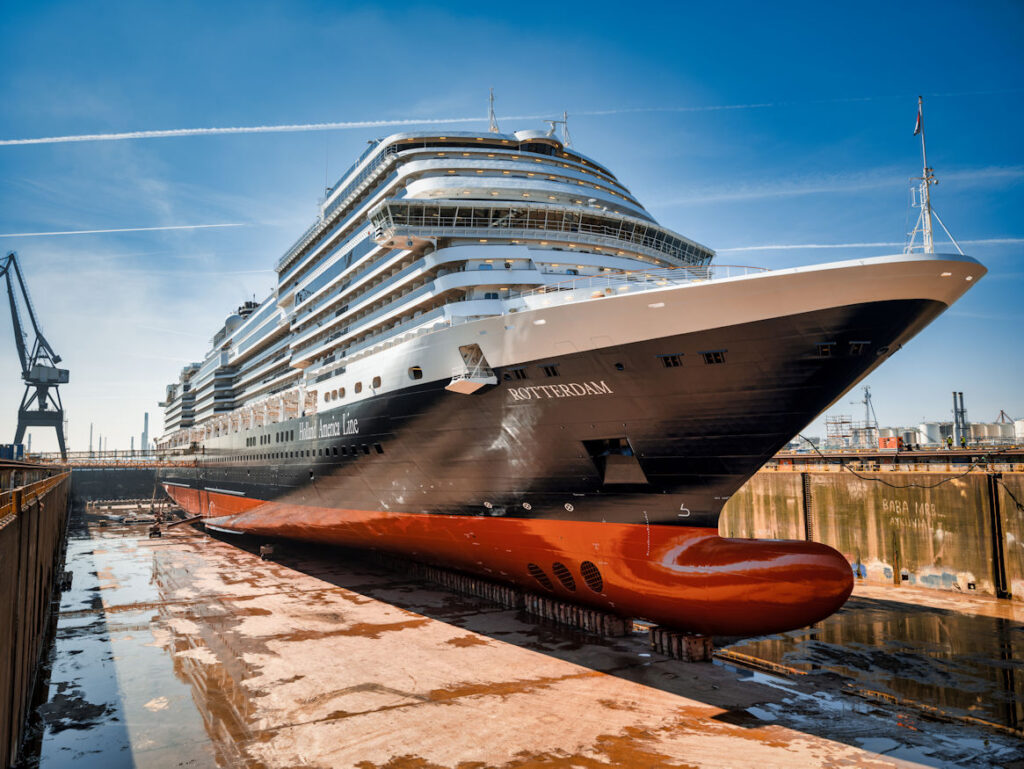
Rotterdam docked in the Botlek yard’s 405m x 90m dry dock for a five-year survey
Reduced ferry engine overhaul time
Danish ferry operator Molslinjen operates the RoPax ferry Hammershus on the Rönne-Köge and Rönne-Sassnitz routes. These routes connect the island of Bornholm with mainland Europe. Molslinjen A/S is Denmark’s largest domestic ferry operator, with a fleet of 20 ships transporting more than 15 million passengers annually.
The challenge was to complete a major engine overhaul on the Hammershus in a tight 14-day dry dock window, which did not allow time for parts to be reconditioned.
Molslinjen needs to ensure that maintenance and overhaul work on its vessels is completed according to carefully-planned schedules because any unplanned downtime would impact service levels and profitability.
Using exchange parts for major engine overhauls avoids the need to wait for parts to be reconditioned or repaired. Exchange parts also avoid challenges with delays relating to lack of availability of workshop labour or components.
Exchange parts are genuine, high-quality original equipment manufacturer (OEM) parts that have been inspected and reconditioned according to strict quality management standards.
Scope of the Wärtsilä solution
Molslinjen selected Wärtsilä to conduct a major 32,000-hour overhaul on both Wärtsilä 31 engines on the Hammershus. The service was delivered through Wärtsilä’s Exchange Parts service.
The exchange power units for the Wärtsilä 31 engines on the Hammershus are complete pre-overhauled cylinder packages consisting of three sub-assemblies:
- the cylinder head
- the cylinder liner and piston with connecting rod
- the guide block.
These ready-to-use components reduced the time and labour Molslinjen needed to reserve for the engine overhaul, which was completed in dry dock. The components removed from the engines were returned to Wärtsilä for reconditioning and re-use through the Wärtsilä Exchange Parts concept.
Molslinjen completed the overhaul of all 16 cylinders, eight per engine, cost-efficiently at a fixed price, which improved budgeting predictability.
Overhauls can be completed in a much shorter time because exchange parts are ready to use immediately. Vessel operators don’t need to wait for old parts to be reconditioned, which can reduce the time needed for an overhaul by up to 37%.
There are three key benefits of using exchange parts:
- less time spent onboard, reducing overall maintenance time
- utilisation of pre-overhauled exchange components, which speeds up maintenance work
- reduced risk of unexpected costs through fixed pricing.
“Significant time savings can be achieved when parts are ready for use directly out of the box,” explains Jan Hauberg Jørgensen, Chief Engineer, Molslinjen. “Additionally, the process of removing and installing the piston, liner and connecting rod in a single lift further optimises efficiency.”
Combined rudder trunk and shaft line repair
MarineShaft has completed a combined rudder trunk and shaft line repair on a vessel at a shipyard in Greece, restoring critical steering and propulsion components to class-approved operating condition.
The project began with an onboard inspection of a misaligned portside rudder trunk. Service engineers measured the damage, defined the repair scope and prepared a class-approved procedure before mobilising specialist machining equipment from Hirtshals, Denmark.
A new rudder trunk lower section was manufactured in-house in 3.2 class-certified S355 steel from the material stock, with chamfer prepared in advance to reduce vessel downtime at the yard.
On site, the remaining trunk section was machined with chamfer for a precise welded joint, and the replacement lower section was positioned and aligned with the steering gear. After welding and post-weld heat treatment, MarineShaft installed mobile machining equipment directly beneath the trunk and machined the lower bearing seat to final dimensions. The bottom surface was also machined to achieve the correct trunk length, followed by assistance with steering gear alignment and full documentation for owner and class.
Additional shaft line repair
During the same visit, damage to the coupling end of the portside aft intermediate shaft was repaired. MarineShaft mobilised portable machining equipment to Greece, where it was installed and aligned in the engine room, allowing the intermediate shaft coupling end to be machined in place.
Scratches and damage from an angle grinder cut were removed by machining the intermediate shaft coupling end, removing 9mm of material to achieve a final diameter of 450mm over a length of 650mm, followed by polishing.
To verify the shaft line condition, jack-up tests were carried out afloat afterwards in both cold and hot static conditions.
The project demonstrates MarineShaft’s ability to combine in-house manufacturing, mobile machining, alignment, heat treatment coordination and class documentation into one efficient repair solution for both steering and propulsion systems.
Underwater ALS cruise ship repair
A major cruise operator required the replacement of air lubrication system (ALS) cover plates on one of its largest passenger vessels during routine port calls in Miami. The vessel, measuring approximately 360m long with a beam of 65m, required the installation of upgraded cover units designed to improve system efficiency and support ongoing vessel performance initiatives. Subsea Global Solutions (SGS) was engaged to complete the underwater removal and installation work while the vessel remained in service, ensuring the project could be completed without interrupting the ship’s operating schedule.
The challenge
The project involved replacing 20 existing ALS cover plates with a newly modified and more efficient design. Because the vessel maintained an active cruise schedule, all work had to be performed during regular port calls with strictly limited working windows. Each cover removed during the operation had to be reinstalled or replaced before the vessel’s departure, leaving no margin for delays.
Additionally, the scale of the vessel and the location of the cover plates required careful underwater rigging and precise coordination between dive teams and topside personnel. The client relied on SGS based on an established working relationship and confidence in the company’s ability to execute technically-demanding underwater work safely within tight operational constraints.
The solution
SGS’s US East Coast team deployed a five-person commercial diving team during scheduled port calls in Miami to complete the ALS cover replacement.
Each operation required divers to unbolt and remove the existing ALS covers, perform controlled underwater rigging operations and install the upgraded units using new fastening hardware. The work demanded careful alignment and secure installation to ensure the integrity of the ALS system and vessel hull.
Throughout the project, strict adherence to the vessel’s departure schedule remained the top operational priority. SGS ensured that any removed cover was fully reinstalled or replaced before the vessel sailed, eliminating operational risk and ensuring the ship could depart each port call on time.
Conclusion
SGS successfully completed the ALS cover replacement across multiple port calls without impacting the vessel’s operating schedule. The project demonstrated the company’s ability to coordinate complex underwater mechanical work within limited service windows while maintaining strict safety and quality standards.
The client reported that while the service met operational expectations, the professionalism of the SGS team and the quality of the installation exceeded expectations, reinforcing the trusted partnership between the cruise operator and SGS.
Cruise robotic first
Carnival Cruise Line has signed an agreement with marine coatings specialist Jotun to implement Jotun’s Hull Skating Solution (HSS), becoming the first cruise operator to use this proactive robotic hull cleaning technology. With this commitment, Carnival continues to utilise innovation and technology to reduce emissions and protect biodiversity.
As one of the world’s largest and most influential cruise brands, Carnival’s adoption of HSS to its vessel Carnival Pride marks an important shift for the wider industry. The technology enables proactive hull cleaning, ensuring that vessels maintain an always-clean hull across typical cruise operations. This proactive approach also reduces fuel consumption, cuts carbon emissions and protects biodiversity.
“Maintaining a clean hull is essential for efficient ship operations, and the Hull Skating Solution allows us to take a more proactive approach to hull maintenance,” said Jari Oinas, AVP of fuel performance and decarbonisation at Carnival Cruise Line. “As we evaluate the technology aboard Carnival Pride, we see strong potential to support ship performance while advancing our long-term sustainability goals.”
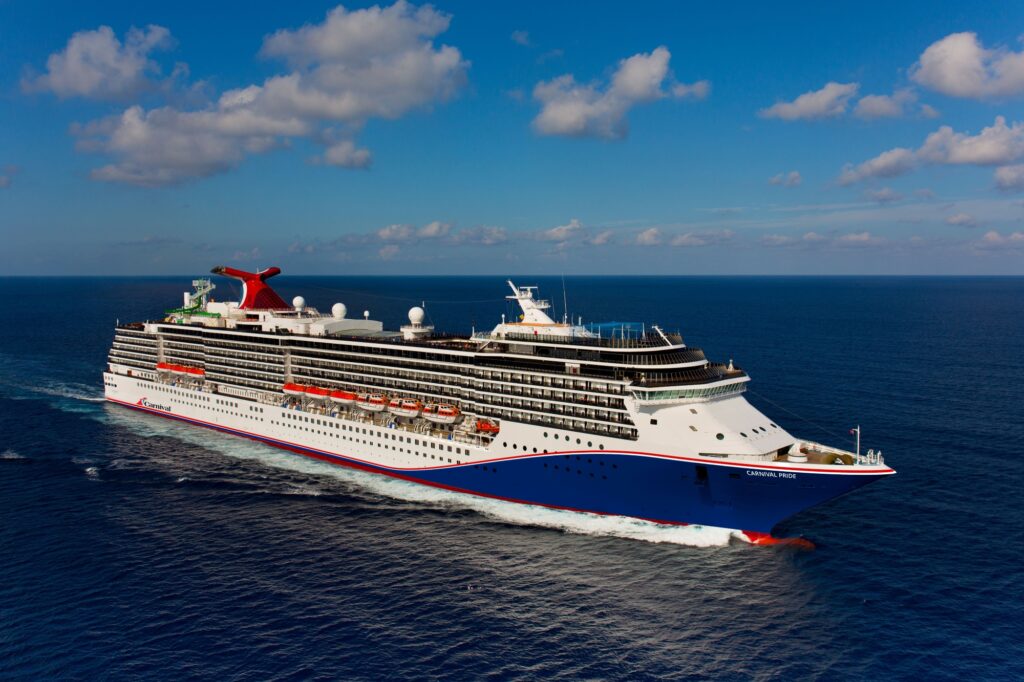
Carnival’s adoption of HSS to its vessel Carnival Pride marks an important shift for the wider industry
Carnival first
Carnival’s move is the first introduction of Jotun’s robotic hull cleaning solution in the cruise sector. “Carnival is demonstrating real leadership by embracing new technology that ensures consistently clean hulls and reduced environmental impact,” says Stein Kjølberg, Regional Vice President Americas for Jotun. “With our 100-year long track record in hull performance, and with presence in the US for over 50 years, we are proud to support an American icon that is both ambitious and forward leaning.”
In addition to the HullSkater device, the agreement includes compatible hull coating, continuous monitoring and hull inspections, hull performance transparency through Jotun’s digital reporting solutions and an always-clean hull guarantee. Jotun recently received independent verification from DNV, verifying an always-clean hull with no measurable speed loss for vessels using HSS.
For cruise operators, the ability to inspect and clean the hull before sailing to the next destination is particularly valuable. By maintaining a clean hull, Carnival can support fuel efficiency, minimise speed loss and reduce the risk of transferring invasive species between various waters and ports.
“Our Clean shipping commitment is dependent on collaborations with partners who dare to innovate,” says Kjølberg, applauding Carnival’s willingness to challenge and disrupt.
Read more articles like this in the latest issue of DryDock magazine